
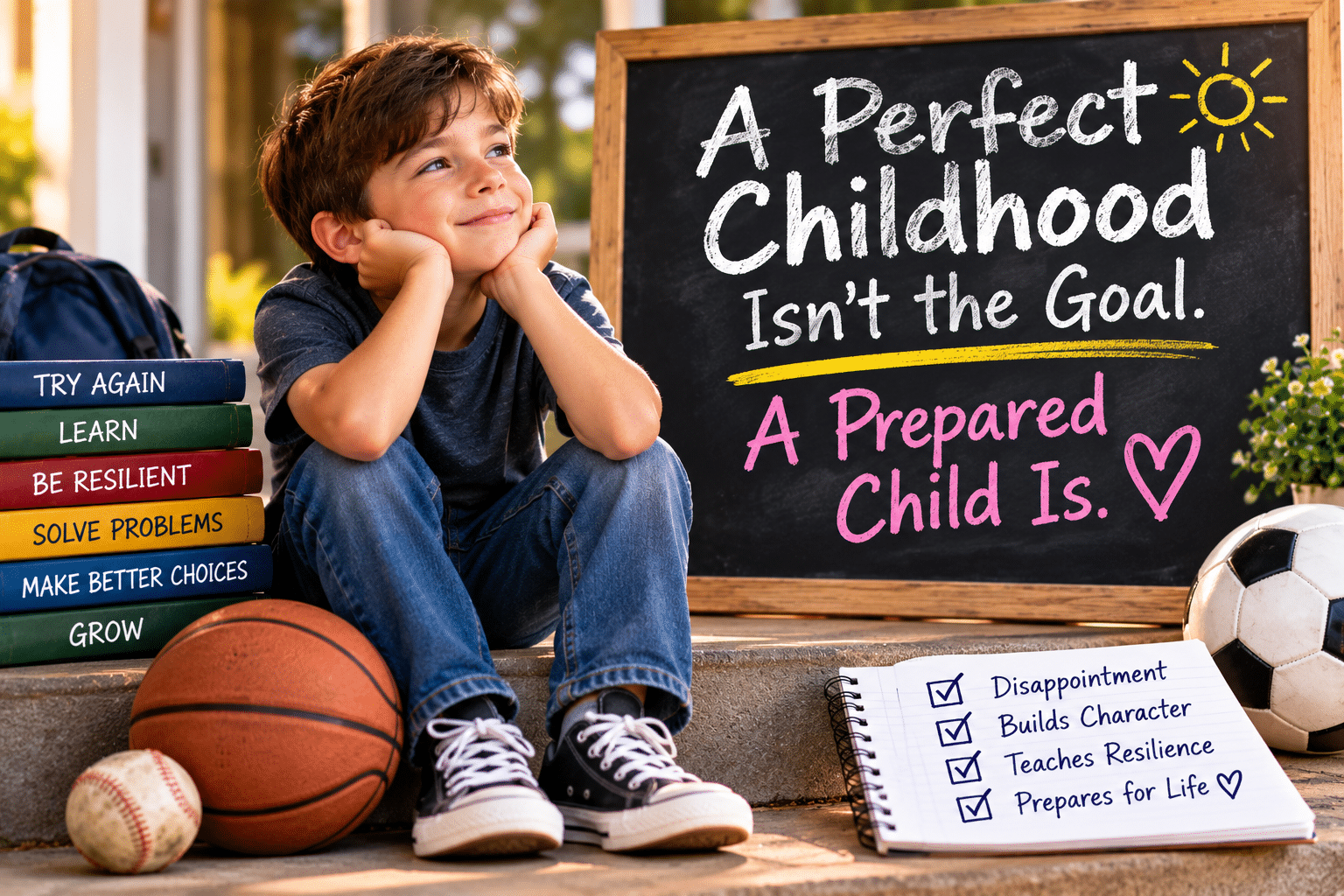
Our kids don’t need a childhood without disappointment. They need a childhood that prepares them for life.
Rock Stars, I have an opinion. I know. Shocking. 😂 I think we’re trying too hard to make childhood perfect. We don’t want our children disappointed. We don’t want them left out. We don’t want them bored. We don’t want them to lose. We don’t want them to get a bad grade. We don’t want the teacher to misunderstand them. We don’t want them sitting on the bench. We don’t want them to struggle. And when something does go wrong, every instinct inside us says: Fix it.
Call the teacher. Email the coach. Bring the forgotten homework. Replace the thing they lost. Pay for the thing they can’t afford. Solve the disagreement. Make the disappointment go away. I understand that instinct. I did it too. But now that I’ve spent 25 years raising children and have watched some of them become adults, I’m beginning to wonder whether some of the things we worked so hard to protect them from were actually things they needed to experience.
I’m Not Talking About Real Harm
Before somebody sends me an email, let me make an important distinction. I am not talking about bullying. I’m not talking about abuse. I’m not talking about dangerous situations, serious mental or physical struggles, or ignoring a child who genuinely needs help. Parents should protect their children. That’s part of the job. I’m talking about something much more ordinary. Disappointment.
Your child didn’t make the team. Someone else got the part. They got a C. Their best friend was invited somewhere and they weren’t. The teacher isn’t their favorite. They spent all their allowance and now they can’t afford something they want. They forgot the homework. They lost the game. They didn’t win the award. They have to wait. They’re bored. Someone told them no. They tried something and weren’t very good at it. Those things stink. And they’re also… life.
Childhood Is the Practice Field for Adulthood
Technology Man has always had a very sophisticated parenting philosophy. We are attempting to produce: “Healthy, wealthy and wise taxpayers who leave home.” Very inspirational. I believe Hallmark will be contacting him any day now. 😂 But there’s actually something important underneath his ridiculous little slogan. Eventually, our children are supposed to leave us.
And adults who leave home occasionally encounter people who don’t particularly care whether they’re disappointed. A boss may say no. A college may reject them. A relationship may end. Someone else may get the promotion. They may make a financial mistake. They may work incredibly hard at something and still fail. Life doesn’t promise everyone a trophy. Sometimes it doesn’t even give you a participation ribbon. So maybe childhood is supposed to be a little bit of a practice field for all of that. And home should be one of the safest places to practice.
A $20 Mistake Is Better Than a $20,000 Mistake
I wrote recently about learning to stop fixing everything for our kids. The older mine have gotten, the more convinced I am that small consequences can be wonderful teachers. I’d rather my child make a $20 mistake at 15 than a $20,000 mistake at 25. Spend all your money? Well… You’re broke.
Welcome to Economics 101. 😂 Forget your homework? Maybe the uncomfortable conversation with the teacher will help you remember it tomorrow. Don’t study for the test? The grade may teach something Mom’s 45-minute lecture wouldn’t. Forget your lunch? You’re probably going to be hungry for a few hours. And before someone panics, I’m not suggesting we starve children.
I’m suggesting that occasionally experiencing the natural result of a decision can be far more effective than having Mom continually remove the result. Because if I fix every mistake, I may accidentally teach: “When something goes wrong, someone else will take care of it.” What I really want them to learn is: “Something went wrong. What am I going to do about it?” That’s a very different lesson.
Sometimes a C Is Just a C
This one is particularly difficult for parents. We see a bad grade and immediately start diagnosing the problem. Was the assignment fair? Did the teacher explain it properly? Was there enough time? Should we ask for extra credit? Should we email? Should we schedule a conference? Sometimes those questions are absolutely appropriate. But sometimes… the kid got a C.
One of my children struggled throughout school and was dyslexic. Another was gifted, on the autism spectrum, and had an incredible memory. Another has completely different strengths and interests. I’ve had enough children now to understand something I should have understood as a teacher: A grade is information. It isn’t an identity.
Sometimes the information is: You need help. Sometimes it’s: You didn’t understand this. And sometimes it’s simply: You didn’t work very hard. Those require very different parenting responses. But none of them require Mom to panic.
Not Getting Picked Can Teach Something Too
This one hurts. Maybe more for us than for them sometimes. You watch your child practice. You know how badly they want it. Then the team gets announced. Or the cast list goes up. Or the awards are handed out. And their name isn’t there. Every Mom cell in your body wants to make it better. You want to explain why the decision was wrong. You want to tell them they deserved it. You want to find somebody responsible.
But maybe what they need most in that moment isn’t for us to change the outcome. Maybe they need us to sit beside them and say: “I know. That hurts.” And then let it hurt for a while. We don’t have to explain every disappointment away. Sometimes loving our children means simply sitting with them while they’re disappointed.
Being Left Out Is Awful
If there’s one childhood pain I would happily eliminate forever, it might be this one. Nobody wants to see their child excluded. It can bring out the mama bear faster than almost anything. But even here, there are lessons our children eventually need. Not everyone will be your friend. Not everyone will like you. You won’t be invited to everything. Some friendships end. Sometimes people choose someone else. And sometimes—this is the uncomfortable one—our child may be part of the problem.
Maybe there’s a behavior that needs to change. Maybe they weren’t kind. Maybe they haven’t been a good friend. Maybe there’s something they can learn from what happened. If I immediately decide my child is always the innocent victim, I may miss an opportunity to help them grow. That’s a hard one. For them. And for Mom.
Boredom Isn’t an Emergency
Can we bring this one back? Please? Somewhere along the way, parents became cruise directors. Every moment apparently needs an activity. A screen. A sport. A lesson. An outing. A craft. Entertainment. When I was a child, saying, “I’m bored,” to an adult was dangerous. They had chores. Lots of chores. 😂
Maybe boredom isn’t something we need to solve. Boredom is where children learn to entertain themselves. It’s where imagination happens. It’s where they build forts out of ridiculous things, invent games with rules nobody understands and occasionally stare at the ceiling long enough to have an original thought. We don’t have to fill every empty space.
I Wish I Had Worried Less
This is where 56-year-old Karen has an enormous advantage over 36-year-old Karen. Hindsight. Of course, this is much easier for 56-year-old Karen to write than it was for 36-year-old Karen to practice. Thirty-six-year-old Karen would like to file an objection. 😂 When you’re standing in the middle of childhood, everything feels important. The grade. The friendship. The team. The teacher. The behavior. The decision. The thing that happened Tuesday.
But now I’ve watched a lot of Tuesdays come and go. Some of the things I worried about tremendously barely mattered. And some of the difficult experiences I desperately wanted to fix probably helped my children grow. Looking back, I don’t wish my children had experienced more pain. I wish I had worried less about some of the pain they did experience.
Because disappointment didn’t ruin them. Struggling didn’t ruin them. A bad grade didn’t ruin them. Losing didn’t ruin them. Being told no didn’t ruin them. Not getting their way didn’t ruin them. Sometimes those moments taught them things my lectures never could.
Maybe Resilience Has to Be Practiced
We talk a lot about wanting resilient children. But resilience isn’t something we can hand them when they turn 18. It has to be built. And I’m not sure you can build resilience without occasionally having something to be resilient about. You can’t learn how to recover from disappointment if you’re never disappointed.
You can’t learn how to solve problems if somebody always solves them for you. You can’t learn how to manage money if somebody always replaces what you spend. You can’t learn how to apologize if you’re never allowed to be wrong. You can’t learn how to fail well if you’re never allowed to fail. Maybe our job isn’t to clear every obstacle from the road. Maybe it’s to walk beside them while they learn how to climb over a few.
Safe Place Doesn’t Mean Easy Place
I want home to be my children’s safe place. Always. Even now that some of them are adults. I want them to know they can call. They can talk. They can tell us when they’ve messed up. They can ask for advice. They can come home and know they are loved. But I’ve realized something: A safe place doesn’t have to be a place without consequences.
In fact, maybe one of the reasons home is so important is because children can experience consequences while surrounded by people who still love them. They can fail and still belong. They can be disappointed and still be loved. They can make a mistake and still have dinner with us. They can lose and come home. They can completely blow it and discover: Tomorrow morning still comes. That’s a pretty important lesson.
Perfect Was Never the Goal
I don’t know when we decided children were supposed to have perfect childhoods. Mine certainly didn’t. Technology Man’s definitely didn’t. Our children’s didn’t. And I’m guessing yours won’t either. There will be teachers they don’t like. Friends who hurt their feelings. Games they lose. Tests they fail. Things they don’t get. Plans that fall apart. Consequences they don’t enjoy. There will be days when life isn’t fair. Because eventually they are going to enter adulthood. And adulthood isn’t fair either. So no, Rock Stars, I don’t think our job is to give our children a perfect childhood. I think our job is to give them a childhood that prepares them for an imperfect world.
Love them fiercely. Protect them when they truly need protecting. Be their safe place. Teach them. Encourage them. Pray for them. Help them when they genuinely need help. But occasionally… let the kid be disappointed.
Let them lose. Let them wait. Let them solve it. Let them hear no. Let them discover that something difficult happened—and the world kept turning. Because one day Mom and Dad won’t be standing beside them fixing everything. And when that day comes, I don’t want my children thinking: “Who is going to solve this for me?” I want them thinking: “This is hard. But I can figure it out.” Maybe that’s one of the greatest gifts we can give them. And if it eventually produces a few healthy, wealthy and wise taxpayers who leave home, Technology Man can say he was right all along.
Just don’t tell him I said that. 😂❤️ — Karen
0 Comments