

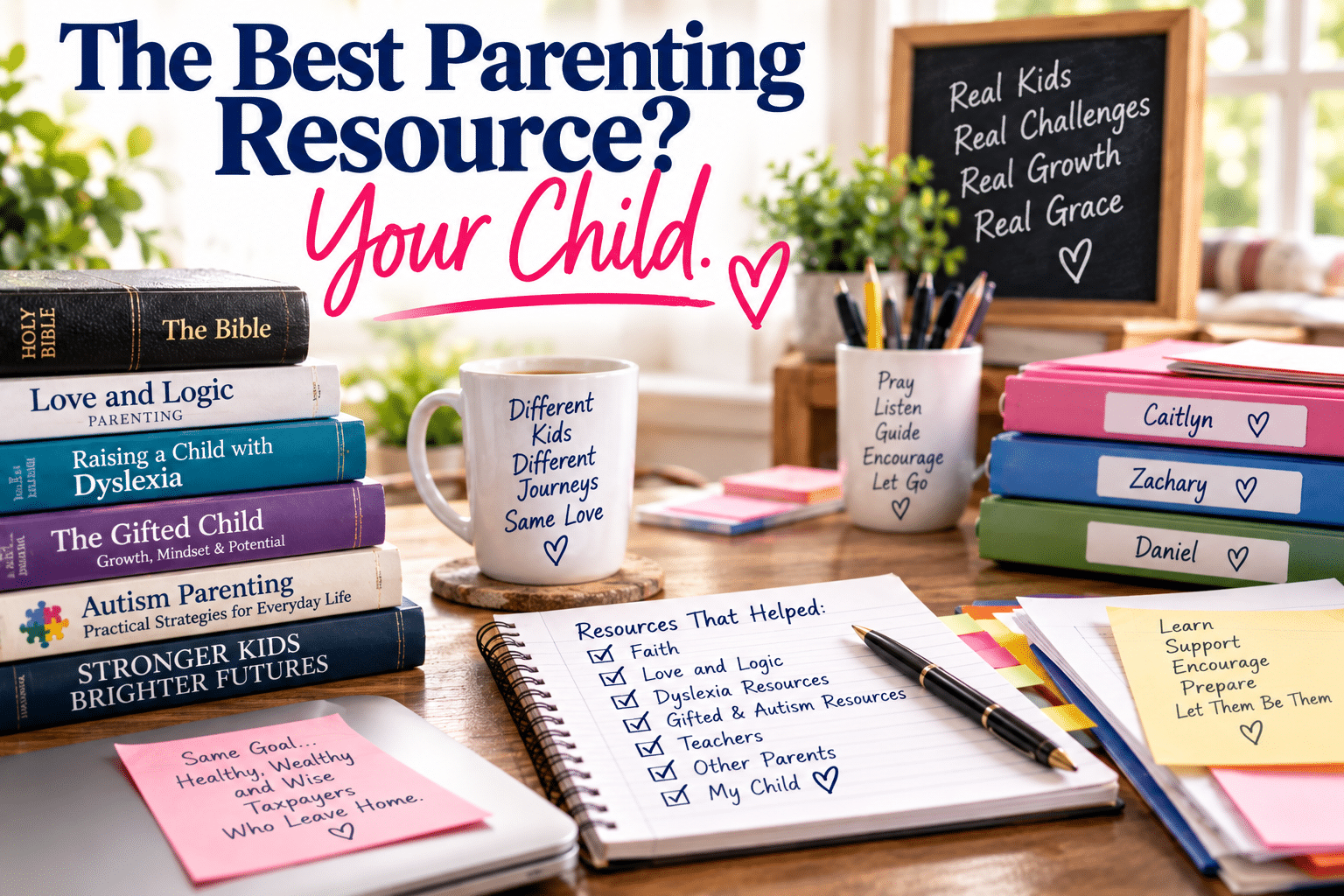
If there is one thing raising three children has taught me, it is this: Kids do not come with instruction manuals. Actually, that’s not entirely true. There are approximately 14 million parenting books, websites, podcasts, Facebook groups, experts, grandparents, teachers and random strangers at the grocery store who are perfectly willing to provide you with one. 😂
The problem is that none of them came specifically written for your child. And I’ve had three very different children. One struggled academically and was dyslexic. One was gifted, on the autism spectrum, had an incredible photographic memory and could memorize things I couldn’t remember five minutes after reading them. And one came along six years later with completely different interests, strengths and challenges.
Throw in a blended family, custody issues, school decisions, activities, teenagers, technology and eventually adult children, and I have spent a lot of years looking for resources. Some helped. Some didn’t. Some worked beautifully with one child and were completely useless with another. So this isn’t my list of the seven things every parent must use. After 25 years, I don’t believe such a list exists. These are simply seven resources—or maybe kinds of resources—that helped me. Maybe one of them will help you too.
1. The Bible
I know. You saw that one coming. ❤️ But I don’t mean keeping a Bible on the nightstand and hoping parenting wisdom somehow transfers through osmosis. I mean actually returning to Scripture when I didn’t know what to do. Parenting has a funny way of exposing the limits of your own wisdom.
When they’re babies, you worry about keeping them alive. Then you worry about whether they’re developing normally. Then school starts. Then friendships. Then grades. Then activities. Then teenagers. Then driving. Then relationships. Then jobs. Then adulthood.
You eventually discover there is always something new you don’t know how to handle. Scripture continually brought me back to things that mattered more than whatever crisis seemed enormous that particular Tuesday: Patience. Self-control. Kindness. Wisdom. Forgiveness. Humility. Perseverance. Grace. And perhaps the hardest one for a mother: Trust.
At some point, our children become responsible for their own decisions. That’s when you discover whether you really believe God loves them even more than you do. I am still working on that one.
2. Love and Logic
One parenting philosophy that made a lot of sense to me over the years was Love and Logic. The basic idea that stuck with me wasn’t some magical parenting script. It was much simpler: Children need opportunities to make choices and experience reasonable consequences while the consequences are still small.
That fits something I believe even more strongly now that some of our children are adults. I’d rather a child make a $20 mistake while living at home than a $20,000 mistake after leaving. If you spend all your money, you’re out of money. If you forget something, sometimes you deal with the inconvenience of forgetting it. If you make a poor choice, Mom doesn’t automatically swoop in and erase every consequence. That doesn’t mean we stop helping our children.
It means we stop assuming helping always means fixing. There’s a big difference. Technology Man particularly likes this philosophy because it fits nicely with his ultimate parenting objective: Healthy, wealthy and wise taxpayers who leave home. I’m fairly certain that’s not the official Love and Logic slogan. 😂
3. Dyslexia Resources—and Learning to Look Beyond Grades
Caitlyn taught me an enormous lesson about education. She struggled through school and was dyslexic. When your child struggles academically, it can be incredibly difficult not to allow school performance to become the measuring stick for everything. But struggling to read doesn’t mean struggling to think. A grade doesn’t measure creativity. A standardized test doesn’t measure compassion.
A report card doesn’t tell you whether your child will become a good spouse, employee, friend or parent. Dyslexia resources helped us better understand how Caitlyn learned. But perhaps more importantly, Caitlyn herself taught us to stop defining intelligence so narrowly. Parents need information about whatever challenge their child is facing. Read. Research. Talk to specialists. Talk to teachers. Learn the terminology. Ask questions. But never let the diagnosis, test result or report card become bigger than the child.
The resource should help you understand your child—not become the definition of your child.
4. Gifted and Autism Resources
Then along came a completely different educational experience. Zachary was gifted and on the autism spectrum. He had an incredible memory. When he was younger, he could memorize the monthly school lunch menu so he knew exactly which days he wanted to bring his lunch. Which was fantastic… until Texas weather interfered.
One ice day threw the school’s meal schedule off by a day. The menu in his head said one thing. The cafeteria served another. For most children that would have been mildly annoying. For Zachary, it was incredibly difficult. That’s when resources about gifted children and autism became important—not because they gave us a magic formula, but because they helped us understand why something that seemed insignificant to us could feel enormous to him.
That’s a major parenting lesson. Sometimes the question isn’t: “Why is my child making such a big deal about this?” Sometimes the better question is: “Why does this feel like such a big deal to my child?” Those are very different questions. Understanding doesn’t mean eliminating every expectation. It means knowing the child well enough to help them navigate the expectation.
5. Teachers
I’m biased here. I was one. 😂 I taught third grade for six years and fourth grade for one. I had bachelor’s and master’s degrees in elementary education. I was certified. I wrote lessons. I studied child development. I had classrooms full of children. I thought I knew kids.
Then I became the parent sitting on the other side of the conference table. Whole different ballgame. Teachers can be tremendous resources because they see something we don’t: our child without us. They see how our child responds to authority outside the home. How they interact with peers. Whether they participate. Whether they give up. Whether they help others. Whether they’re organized. Whether they’re struggling quietly. Does every teacher understand every child perfectly? Of course not.
Teachers are human. Parents are human. Children are definitely human. But I’ve learned that going into a conversation with a teacher thinking, “What can you help me understand?” usually gets us much farther than going in preparing for battle. You don’t have to agree with everything. Just listen first. There may be information there you need.
6. Other Parents—With One Giant Warning Label
Other parents can be one of the greatest resources you have. They know things. They’ve tried things. They’ve found doctors. They know teachers. They’ve navigated programs. They’ve survived stages you haven’t reached yet. There is tremendous wisdom in community.
But this particular resource needs a giant warning label: DO NOT USE FOR COMPARISON. Your friend’s child reading at age four does not mean your child is behind in life. The kid who got into the impressive college isn’t evidence you failed. Someone else’s child making varsity doesn’t diminish yours. Another family may have different finances, personalities, abilities, opportunities and challenges.
Learn from other parents. Ask questions. Share resources. Encourage one another. But be very careful about using somebody else’s child as the measuring stick for yours. Comparison can turn a wonderful resource into a source of unnecessary anxiety incredibly quickly.
7. Your Child
It took me a long time to figure this one out. I spent years looking for experts who could tell me how to parent my children. And experts helped. Books helped. Teachers helped. Doctors helped. Other parents helped. Church helped. School helped. Experience definitely helped.
But eventually I discovered something. Caitlyn was the best resource for learning how to parent Caitlyn. Zachary was the best resource for learning how to parent Zachary. Daniel has been the best resource for learning how to parent Daniel.
They’re different. Really different. And sometimes I think we make parenting harder by asking: “What works with kids?” when the better question is: “What does this kid need?” One child may need encouragement. Another needs structure. One needs you to push. Another needs you to back off. One wants to talk immediately. Another needs an hour before they’re ready. One may need help. Another desperately needs you to stop helping. And just about the time you finally figure that child out… they grow. Very inconsiderate. 😂 Then you have to learn them all over again.
Resources Are Tools, Not Formulas
Maybe that’s my biggest recommendation. Use resources. Lots of them. Read books. Search for information. Ask teachers. Talk to doctors and specialists when appropriate. Listen to experienced parents. Use your church community. Learn everything you can. But hold parenting formulas loosely. Because your goal isn’t to raise somebody else’s child correctly. Your job is to learn the child God put in front of you.
Twenty-five years ago, I probably wanted someone to hand me the parenting manual. Today I’m not sure I would want one. Because raising Caitlyn taught me things Zachary couldn’t have taught me. Raising Zachary taught me things Daniel couldn’t have taught me. And raising Daniel continues to teach me things I apparently didn’t learn the first two times around. 😂
They’re three different stories. Three different personalities. Three different sets of strengths. Three different collections of struggles. And three different people who eventually have to live their own lives. So by all means, Rock Stars… build your parenting bookshelf.
Collect resources. Take notes. Highlight things. Bookmark websites. Ask questions. Pray. Learn. Then occasionally close the book. Put down the phone. Look at the child standing in front of you. And listen. Because sometimes… the parenting resource you’ve been looking for is sitting right across the table. ❤️ — Karen
0 Comments