

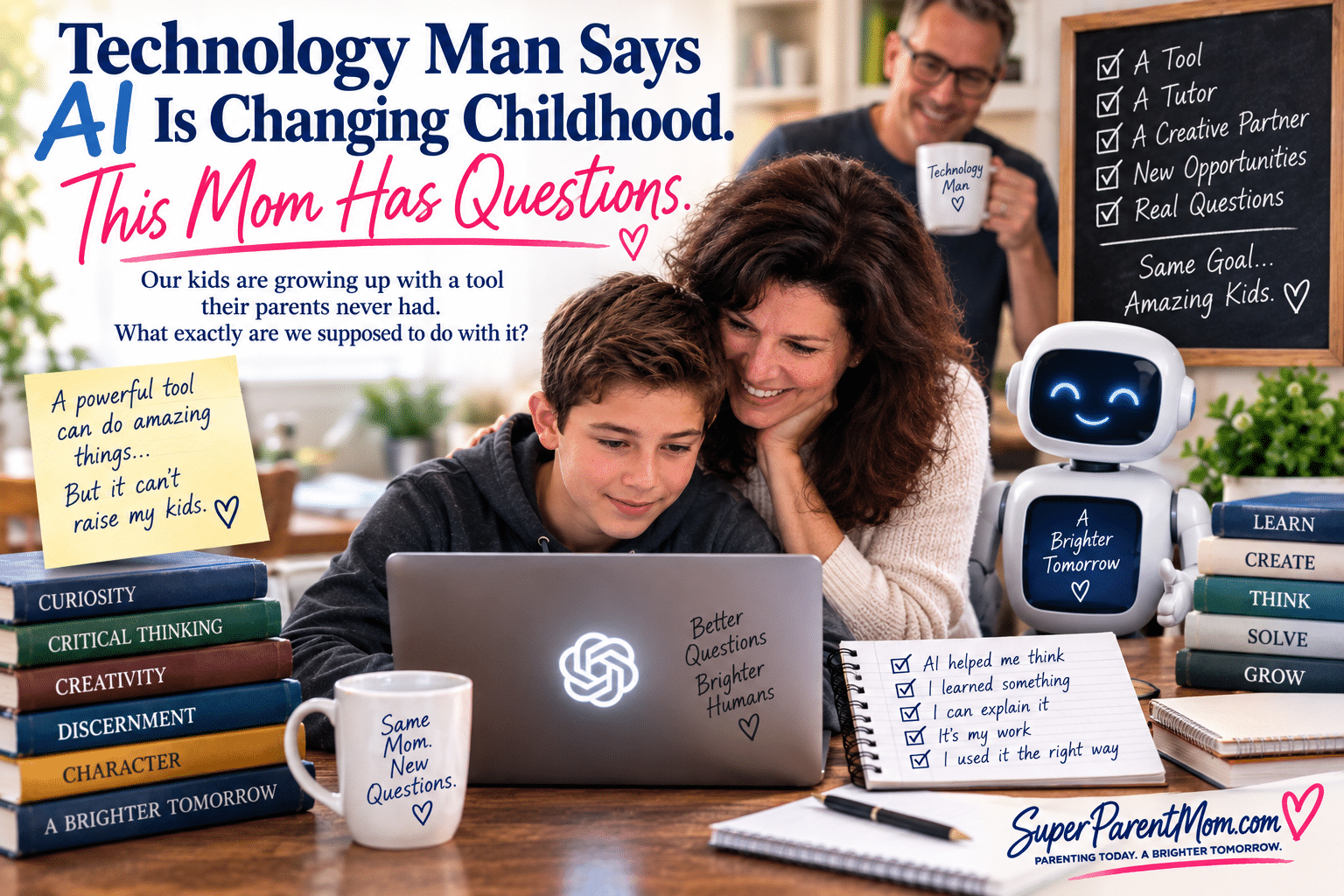
Our kids are growing up with a tool their parents never had. What exactly are we supposed to do with it?
Rock Stars, I married a man I have called Technology Man on this blog for years. This was cute when it meant he knew how to fix the Wi-Fi. Things have escalated. Technology Man now spends an alarming amount of time talking about artificial intelligence. AI is going to change business. AI is going to change education. AI is going to change jobs. AI is going to change how we search for information. AI is going to change how people create things. AI is going to change everything.
Wonderful. I’m a mom. I have a slightly different question: What is it going to do to our kids?
I Remember When Google Was the Problem
I taught elementary school before Google became something we used as a verb. When I was teaching, children researched things using books. Actual books. There was an encyclopedia involved. You had to find the right volume, look something up alphabetically and then actually read enough of the page to figure out whether it contained what you needed. If you wanted to copy something, you had to physically write it down.
I’m beginning to sound 106 years old. But stay with me. 😂 Then came the internet. Then Google. Then smartphones. Then social media. Each time, parents and teachers had to figure out what the new technology meant for children. Now we have AI.
And this one feels different. Because AI doesn’t just find information for our children. It can actually do the assignment.
“Write My Book Report”
This is where Former Teacher Karen starts getting nervous. A student can now type something like: Write me a five-paragraph essay about Charlotte’s Web. And a computer can produce one. Quickly. No staring at the blank page. No rough draft. No trying to figure out what Charlotte represents.
No asking Mom at 9:47 p.m. why the printer suddenly doesn’t work when the project is due tomorrow. Technology Man probably considers that last one progress. 😂 But as a teacher and a mom, I have to ask: If the computer does the thinking, what exactly did the child learn? That’s the part of AI that concerns me. Not because I think technology is evil. Obviously I don’t.
I married Technology Man. But childhood is supposed to involve struggle. Not terrible struggle. Not unnecessary struggle. But the kind that happens when you don’t know something yet and have to figure it out. That process matters.
Then Technology Man Makes a Good Point
I hate when this happens. Because while I’m imagining an entire generation of children asking computers to do their homework, Technology Man sees something else. A tool. And when I really think about our own children, I can see his point.
Caitlyn struggled in school and was dyslexic. Imagine having a patient tutor available whenever she needed one that could explain something again, simplify directions, help organize her thoughts or present information in a different way. That’s pretty incredible.
Zachary was gifted, on the spectrum and endlessly curious. Imagine handing that child a tool capable of answering his 4,782nd follow-up question about whatever subject had captured his attention that week. Actually, maybe I would have paid for that subscription myself. 😂
And Daniel has developed completely different interests, particularly in creative areas like animation. The tools available to him today allow a young person to create things that would have required expensive equipment, specialized software and an entire team not very long ago.
So maybe AI isn’t simply something children need protection from. Maybe it’s also something they need to learn how to use well.
Yesterday’s Lunch Menu Got Me Thinking
I recently wrote about Zachary memorizing his entire monthly school lunch menu when he was little. He knew which days he wanted to buy lunch and which days he wanted to bring it. Then Texas had an ice day, the cafeteria schedule shifted, and suddenly the menu in his head didn’t match reality. That was a big deal for him.
But think about how much the world has changed. Zachary memorized information. Today’s child can simply ask a machine. And that raises an uncomfortable question for this former teacher: What should children still know when almost everything is instantly knowable?
I don’t have a perfect answer. But I don’t think the answer is: Nothing. Just ask AI.
Information Isn’t Wisdom
This may be the biggest lesson I want my children—and eventually grandchildren—to understand about AI. Having access to information isn’t the same thing as understanding it. And understanding something isn’t the same thing as having wisdom. A computer can give you an answer. But is the answer true? Is it complete? Is something important missing? Is there another side? Does the answer make sense? Should you act on it? What are the consequences?
Those questions require something more than access to information. They require judgment. Technology Man can probably explain how artificial intelligence processes information. Mom is still going to ask: “Okay, but should you do that?” Both questions matter.
Maybe the Questions Have Become More Important Than the Answers
For generations, school rewarded children for knowing answers. What’s the capital of France? What year did this happen? Define this word. Solve this equation. Those things still matter. But when a child carries a device capable of answering millions of questions almost instantly, another skill becomes incredibly important: Can the child ask a good question?
Can they recognize a bad answer? Can they compare information? Can they explain something in their own words? Can they take what they’ve learned and apply it somewhere new? Can they think critically about what they’re being told? Can they say: Wait a minute. That doesn’t sound right. Maybe education in the AI generation becomes less about producing children who can repeat information and more about producing children who know what to do with information.
Here’s the Rule I’d Use With Homework
If I were raising little children again today, I don’t think I would ban AI. I’m not sure that would even be realistic. Instead, I’d probably keep asking one question:
Did AI help you think, or did AI think for you?
There’s a difference. “Explain fractions to me another way.” Great. “Quiz me on these vocabulary words.” Great. “Help me brainstorm five ideas for my project.” Could be great. “I wrote this paragraph. Help me understand why it isn’t clear.” Useful. “Write my entire assignment so I can paste my name on it.” Nope.
That isn’t using a tool. That’s outsourcing the learning. And I’d add one more test: Would you be comfortable telling your teacher exactly how you used AI? If the answer is no, that’s probably worth thinking about.
Don’t Let the Machine Steal the Struggle
I’ve written recently about letting our kids struggle. I think that applies here, too. We parents have always been tempted to rescue our children. Now they have a machine willing to rescue them in about three seconds. Can’t think of an opening sentence? AI can do it. Don’t understand the math problem? AI can solve it. Don’t want to read the chapter? AI can summarize it. Don’t know what to draw? AI can make it. Don’t know what you think?
That’s the one that worries me. Because figuring out what you think is part of becoming an adult. Sometimes the blank page is good for you. Sometimes wrestling with the math problem is good for you. Sometimes reading the boring chapter is good for you. Sometimes being frustrated long enough to finally figure something out is exactly where learning happens. Efficiency isn’t always the goal. Especially during childhood.
Our Kids Will Need Different Skills
I don’t know exactly what the job market will look like when today’s elementary students become adults. Technology Man has theories. Technology Man always has theories. 😂 But I’m increasingly convinced that our children are going to need some skills even more than previous generations did. They’ll need curiosity. Creativity. Critical thinking. Communication. Adaptability. Perseverance. Discernment. And integrity.
They’ll need to know how to learn something new because whatever they learned ten years earlier may no longer be enough. They’ll need to know how to work with technology without becoming completely dependent upon it. And they’re going to need character. Because technology can tell you what you can do. Character helps determine what you should do.
AI Can’t Raise My Kids
This may be where Technology Man and I actually agree most. AI can help a child learn. It can explain. It can tutor. It can brainstorm. It can create. It can answer questions. But it cannot take over the most important parts of parenting. It cannot teach our children character unless somebody models character. It cannot teach them honesty if the adults around them aren’t honest. It cannot teach them compassion by simply defining compassion. It cannot replace family conversations.
It cannot replace consequences. It cannot replace encouragement. It cannot replace faith. And it certainly cannot replace parents being involved enough in their children’s lives to notice who they’re becoming.
Technology Changes. Parenting Doesn’t Change Quite as Fast.
When I started teaching, there were no smartphones in my classroom. When I started raising children, there was no ChatGPT helping with homework. By the time my future grandchildren are in school, they’ll probably be using technology that would sound ridiculous to me today. I can’t predict all of it. And I’m finally old enough to know better than to try. But I don’t think the basic job changes very much.
Teach them to tell the truth. Teach them to work. Teach them to think. Teach them to ask questions. Teach them to create. Teach them to treat people well. Teach them to handle failure. Teach them to recognize that knowing something and being wise are not the same thing. Teach them that powerful tools come with responsibility. And teach them that just because a machine can do something for them doesn’t always mean it should.
Rock Stars, I don’t think parents need to become artificial intelligence experts. Thank goodness. Technology Man has that department covered around here. But we do need to remain experts on something much more important: our children. Know what they’re doing. Know what they’re learning. Know what they’re struggling with. Know what they’re creating. Ask them questions. And occasionally make them figure something out without immediately asking a machine.
Technology Man can teach them the AI. I’ll keep working on the humans. ❤️ — Karen
0 Comments