

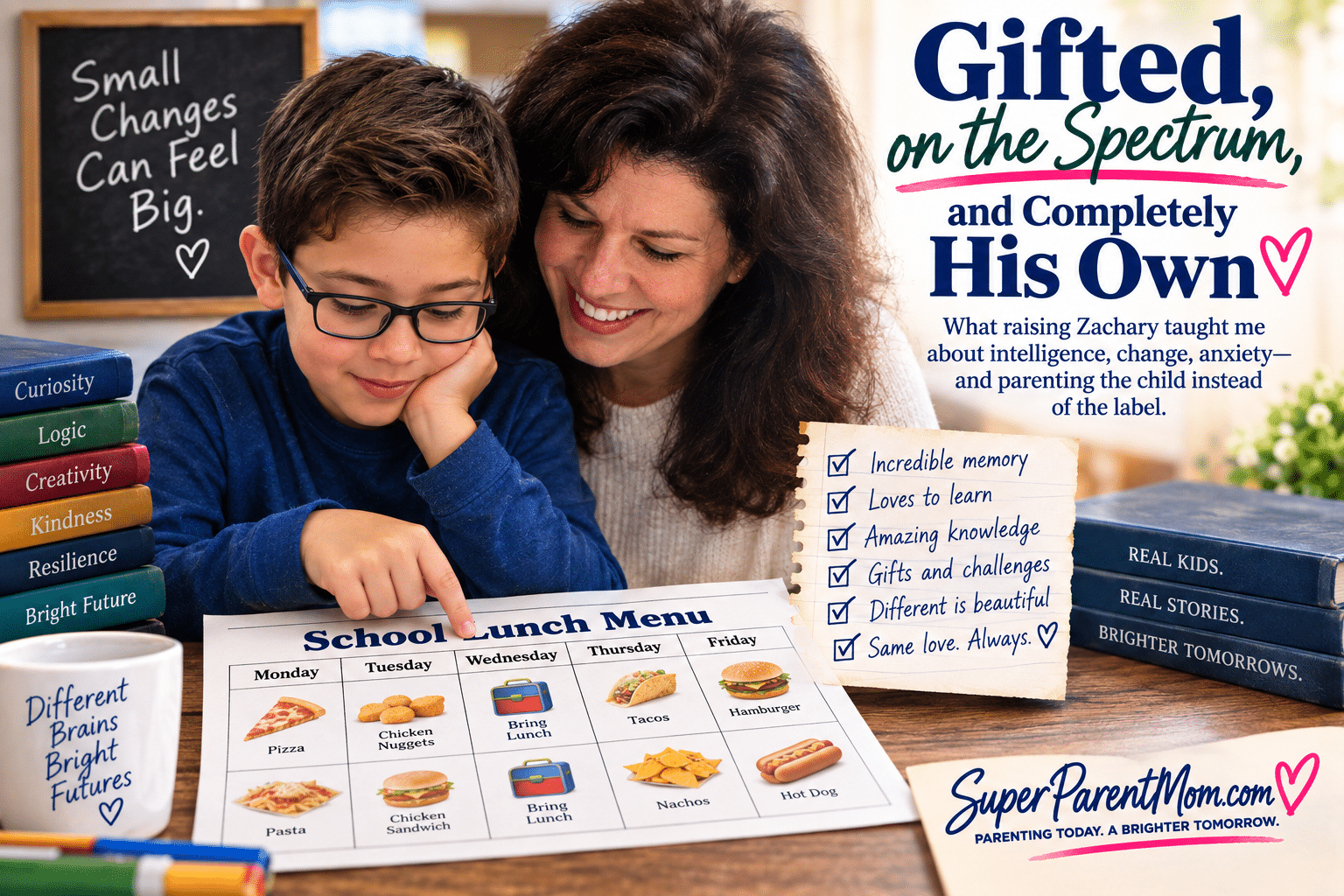
What raising Zachary taught me about intelligence, change, anxiety—and parenting the child instead of the label.
Rock Stars, yesterday I wrote about how your child is more than a report card. I should probably follow that with another confession from this former teacher: Your child is more than a label, too. And we’ve had a few labels around here. When Zachary was young, it became obvious pretty quickly that his brain worked differently.
His memory was incredible. We used to describe it as almost photographic. His knowledge base amazed us. He had an unusual ability to learn languages. His logic could be impressive—and occasionally exhausting if you happened to be the parent trying to explain why he needed to do something he had logically determined was unnecessary. He was gifted. He was also on the autism spectrum. And for a while, I think I mentally separated those things. There were the things his brain did that amazed us. And there were the things his brain did that made everyday life harder. It took me time to understand: They weren’t two different children.
They were Zachary.
The Lunch Menu Incident
If you want to understand what life with young Zachary could be like, I can probably explain it with a school cafeteria menu. When Zachary was younger, the school sent home the monthly lunch menu. Most children probably glanced at it. Most parents probably stuck it on the refrigerator. Zachary? He memorized it. The whole month. He wanted to know which days the cafeteria was serving something he wanted to eat and which days he would need to bring his lunch from home.
So he learned the schedule. Monday: cafeteria. Tuesday: cafeteria. Wednesday: bring lunch. And so on. Honestly, it was pretty impressive. Then Texas weather entered the story. We had an ice day. School was canceled. When everyone returned, the cafeteria schedule had gotten shifted. The meal that was supposed to be served one day was now being served the next. To most of us, this wouldn’t even register as a problem. Okay. Tuesday’s lunch is being served Wednesday. Moving on.
Zachary couldn’t just move on. The schedule was wrong. The menu in his head said one thing. Reality said something else. And he had a very difficult time handling it. At the time, I’m sure Technology Man and I were mostly thinking: It’s lunch. But it wasn’t really about lunch. Looking back now, that little cafeteria crisis tells me so much about how Zachary experienced the world. The same brain that gave him an extraordinary ability to memorize the schedule also made it incredibly difficult when the schedule suddenly changed.
We couldn’t celebrate one part of the way his brain worked and simply become frustrated with the other. They were connected. They were both him.
Gifted Doesn’t Mean Easy
I think there’s a misconception about gifted children. People hear the word gifted and imagine parenting on easy mode. Your child is smart! Wonderful! School will be easy. Homework will be easy. Learning will be easy. Parenting will be easy. Excuse me while all the parents of gifted children finish laughing. 😂 Zachary could understand things far beyond what I expected for his age. But understanding something intellectually didn’t necessarily mean he could handle it emotionally.
He could remember enormous amounts of information and still become overwhelmed when something unexpected happened. He could reason through something with remarkable logic while struggling with social situations that seemed effortless for other children. He could learn quickly and still need repetition and order. He could be incredibly capable and incredibly anxious. Giftedness didn’t cancel out his struggles. And his struggles didn’t cancel out his gifts.
Sometimes Smart Kids Are Still Little Kids
This was probably one of the hardest things for me to remember. When a child talks beyond his years, remembers beyond his years or reasons beyond his years, it’s very easy to start expecting him to behave beyond his years. But those things don’t necessarily develop together. A child might discuss something with you at an amazingly sophisticated level… …and then completely fall apart because the cafeteria served the wrong lunch.
That can be confusing as a parent. You understand THAT, but you can’t handle THIS? Yes. Because development isn’t a straight line. And giftedness doesn’t magically make every part of a child equally advanced. Sometimes the hardest thing about raising a child who’s ahead in one area is remembering that he’s still exactly his age everywhere else. And in some areas, he may need more help than other children his age.
I Had to Stop Parenting the Child I Expected
I was a teacher before I was a mom. I had bachelor’s and master’s degrees in elementary education. I had spent years studying children. Surely I knew what I was doing. That’s adorable, isn’t it? 😂 Then God handed me actual children. And, apparently, none of them had read my textbooks. With Zachary, I had to learn that the goal couldn’t be to make him respond to the world exactly the way other children did.
The goal was to understand how he experienced the world and then help him learn to live successfully in it. Those are very different things. When plans changed, telling him “It’s no big deal” didn’t necessarily help. To him, sometimes it was a big deal. That didn’t mean we could rearrange the entire world so nothing unexpected ever happened. We couldn’t. And we shouldn’t.
Instead, we had to help him gradually learn: Plans change. Schedules change. People change their minds. Things don’t always happen the way you expect. And when that happens… you can handle it.
Acceptance Doesn’t Mean Removing Every Challenge
I think this distinction matters. Understanding why something is difficult for your child doesn’t mean making sure your child never has to experience it. The world wasn’t going to reorganize itself around Zachary’s expectations. His teachers couldn’t guarantee that every day would go exactly according to schedule. Employers won’t. Friends won’t. Churches won’t. Families certainly won’t. And Texas weather definitely won’t. 😂
So part of loving him was providing the structure and predictability he needed. But another part was gradually helping him develop the ability to cope when that structure disappeared. Not: “Why can’t you just deal with it?” But: “I know this is difficult. Let’s figure out what to do when this happens.” That’s a lesson I wish I’d understood more clearly when he was little.
The Gift and the Struggle Can Live in the Same Place
As parents, I think we naturally start making two lists.
The Gift List
Amazing memory. Languages. Logic. Knowledge. Ability to absorb information.
The Problem List
Anxiety. Difficulty with change. Need for repetition. Social struggles. Rigidity. But children aren’t lists. For years, I wanted to help Zachary keep all the extraordinary parts of the way his mind worked while fixing the difficult parts. Eventually, I began to understand that it wasn’t nearly that simple. Some of the characteristics that made life challenging were intertwined with the characteristics that made his mind remarkable.
So the question became less: How do we fix this? And more: How do we help Zachary understand himself and learn how to navigate the world with the brain God gave him? That’s a very different kind of parenting.
Don’t Become So Fascinated by the Gift That You Miss the Child
There’s another danger with gifted children. We can become so impressed by what they can do that we start building their identity around it. You’re so smart. You’re gifted. You’re the one who remembers everything. Those sound like compliments. And they are. But what happens when the smart child finally encounters something he can’t do? What happens when something doesn’t come immediately? What happens when another person is better? What happens when intelligence can’t solve the problem? Eventually, every gifted child encounters something difficult.
And I wanted Zachary to know: You don’t have to be the smartest person in the room to have value. You can struggle. You can ask for help. You can fail. You can learn. You can change. Your worth was never hiding inside an IQ score.
Now I Look at Different Things
Zachary isn’t that little boy memorizing the cafeteria menu anymore. Today he’s grown. He’s working full-time at a church and studying toward youth ministry. And I find it interesting that the questions I ask about him today are different from the questions I asked when he was little. Back then, I wondered: How smart is he? What will he do with that memory? How far ahead is he? What will he become?
Today, I’m much more interested in questions like: Is he kind? Does he serve others? Does he work hard? Can he handle things that don’t go according to plan? Can he build relationships? Can he use his abilities to help other people? Does he love God? Can he keep learning? Can he become the man God created him to be? Those things don’t fit neatly on a gifted-and-talented assessment. Maybe they’re the things that mattered most all along.
Life Doesn’t Follow the Lunch Menu
I wish I could tell little Zachary that life eventually becomes predictable. It doesn’t. In fact, adulthood may be one enormous exercise in discovering that the cafeteria changed the menu again. Plans change. Jobs change. People change. Relationships change. Technology changes. Families change. Things we thought were certain turn out not to be. And sometimes Texas freezes over and messes up the entire schedule. But here’s what I would tell the younger version of myself: Don’t try to remove every ice day.
Help him learn that he can survive Wednesday even when Wednesday suddenly has Tuesday’s lunch. Give him structure. Prepare him for changes when you can. Respect the fact that some things really are harder for him. Challenge him. Encourage him. Laugh with him. Pray for him. And don’t become so fascinated by what your child can do that you lose sight of who your child is becoming. Rock Stars, if you’re raising a gifted child, a child on the spectrum, or simply a child whose brain doesn’t seem to operate according to the instruction manual everyone else received, remember this:
Parent the child, not the label. The label may help you understand them. It may help you find resources. It may help teachers know how to support them. But it will never tell you the whole story. Zachary was gifted. Zachary was on the spectrum. Zachary was anxious. Zachary had an incredible memory. And Zachary was—and still is— completely his own. The final report card isn’t in yet. But I’m learning that maybe it was never about the report card anyway. ❤️
— Karen
0 Comments
Trackbacks/Pingbacks